
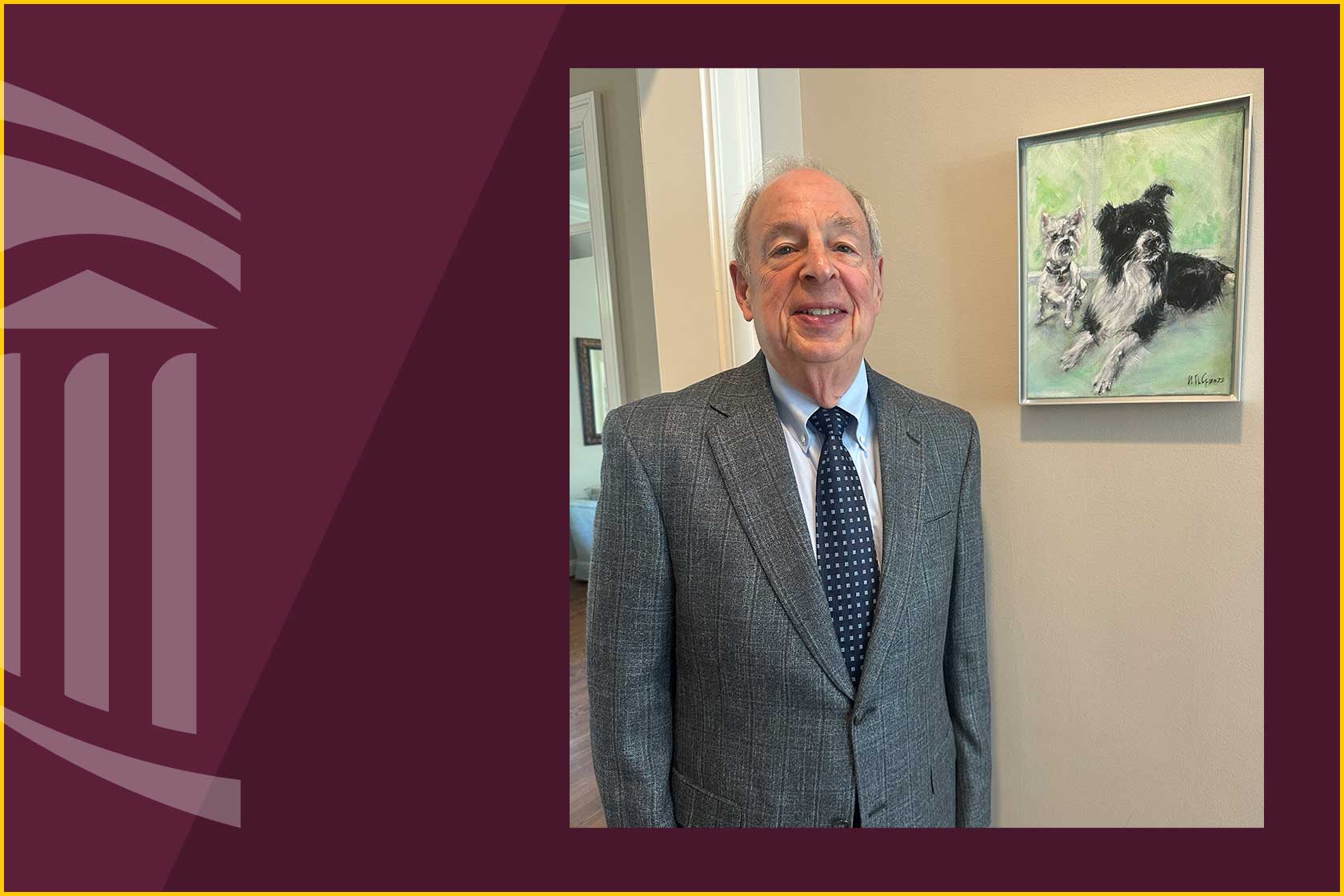
"To teach students how to be lawyers," Professor Dan Goldberg says, "you need to understand the law and its supporting theory, the practice of tax and business law, and have a sense of what lawyers actually do with the law."
That philosophy has guided nearly five decades of teaching at the University of Maryland Francis King Carey School of Law, where Goldberg shaped generations of lawyers by insisting that legal education extend beyond doctrine and into the realities of practice. He was able to capture second year law students and instill in them an interest in income tax and an understanding that tax comes up throughout law practice.
As Goldberg retires, he brings to a close a remarkable career that has helped define tax education at Maryland Carey Law while leaving an enduring mark on generations of students, colleagues, and the legal profession.
A graduate of Harvard Law School in 1971 and a member of its Law Review, Goldberg began his legal career practicing corporate law in New York before moving to Washington, D.C., where he practiced tax law. Since joining the faculty in 1978, Professor Daniel Goldberg has anchored the law school's tax curriculum by teaching foundational and advanced courses, including Federal Income Taxation, Taxation of Business Enterprises, Corporate, Partnership, and International Taxation, and specialized seminars in Tax Policy and Business Planning.
He has also authored more than 20 scholarly publications, become a nationally respected voice in tax policy, and taught thousands of students to think like transactional lawyers.
Learning the Work of Lawyers
For most of his teaching career, Goldberg taught Income Tax, Corporate Tax, Partnership Tax, and Tax Policy, teaching students how to understand the law in each area as a system with interrelated components that has a fundamental logic to it.
He made tax law understandable by breaking the law into its component parts and showing how the parts fit into a logical system, then hanging the rules and exceptions onto the logical system. It was hard work for students but it made their understanding of the complex tax system and their success in “getting it” possible and rewarding.
In their law practice, that understanding in each area would enable students both to identify and answer specific tax-related questions and use the tax law for planning and understanding transactions. They would also understand the impact of tax law and tax policy on individuals’ personal and business lives. Many students went on to build on that understanding in pursuing their own work in law firms, government, and corporations, whether in the tax specialty or in transactional work, where an understanding of tax law is essential.
Later in his teaching career, he built on his tax expertise to write on tax policy issues in tax journals, and his Oxford University Press published book: The Death of the Income Tax, a book cataloguing the failures of the current income tax system and advocating for a consumption tax, in which taxation would be based on what taxpayers consumed rather than on what they earned.
Professor Goldberg’s teaching focus later enlarged to include the importance of tax in planning business transactions. He began teaching a seminar with then Professor (now Judge) Harner in Business Planning, which he took over as a solely run seminar when Professor Harner became Judge Harner in Federal Bankruptcy Court in 2017.
Goldberg's Business Planning course became the foundation for the manuscript, which he used as classroom teaching material and he hopes to complete in retirement, representing the product of his efforts of decades, spent both teaching students to be tax and/or business lawyers and “of counsel” practicing with law firms.
"Seeing things in real life," he says, "is really important if you want to teach students who are actually going to enter real life." It is this insistence on focusing on the actual practice of law that distinguishes Goldberg's most recent endeavor for teaching in his latest undertaking: the Business Planning seminar.
Unlike most courses, where traditional legal education leans heavily on appellate opinions and litigation narratives for teaching law, Goldberg, in his Business Planning seminar, orients his students toward the work of lawyers in transaction practice—the quiet, complex, often invisible work that occupies so many lawyers’ billable hours. In the seminar students move through the life of a business, from formation in an LLC, to financing, then through growth, venture capital financing, acquisitions, and eventual sale, learning not only the governing legal rules but how those rules intersect with accounting, finance, negotiation, and client objectives.
In his seminar, students do not simply learn what the law is; they learn what lawyers do: drafting agreements, preparing and negotiating representations and warranties, navigating due diligence, and structuring transactions under the ever-present shadow of tax consequences. They learn to solve problems before disputes ever arise.
For all the technical rigor, in his Income Tax, Partnership Tax, Corporate Tax, Tax Policy and Business Planning courses and seminars that he has taught over the 48 years he has been on the Maryland faculty, Goldberg's work is animated by something more personal. He wants his students to understand the human stakes embedded in every transaction. He makes students believe that there are people in that company even if those people exist only in a classroom hypothetical.
Goldberg accomplishes this goal by simulating a series of actual decisions and transactions in the life of a growing company, in the case of his latest endeavor, Business Planning. He believes this teaching approach to be particularly useful ,and indeed, to provide a significant headstart, for students entering transactional practice.
Scholarship Grounded in Practice
Goldberg's scholarship has always reflected the same disciplined approach that characterizes his teaching. When asked how he approaches writing (particularly, tax policy articles and his book chapters), his answer is strikingly simple: establish the foundation, identify the issue, and then examine the repercussions.
"You need to understand the structure before you can understand the problem," he explains. "And once you understand the problem, you need to understand what follows from it."
That framework has guided his scholarship spanning tax law, business law, and tax policy. His scholarship consistently combines rigorous legal analysis with practical application, helping readers understand not simply what the law says (or even should say), but why it matters.
Throughout his career, Goldberg has been a thoughtful advocate for consumption-based taxation, approaching even controversial policy questions with careful analysis rather than rhetoric. His articles and tax policy consumption tax book, The Death of the Income Tax, also involve that same approach.
His years in “of counsel” practice continually informed that scholarship. During the dot-com era, entrepreneurs flooded lawyers' offices seeking advice on entity formation, financing, and tax planning. Goldberg experienced firsthand how startups transformed the business landscape. "The startups were everywhere," he recalls from his “of counsel” years. "Everyone was looking for advice—how to structure the business, how to raise capital, how to handle tax issues, how to prepare for growth."
At a time when incorporation remained the conventional wisdom for new businesses, Goldberg recognized the advantages of limited liability companies long before they became today's standard organizational form. Law is a structure based on precedent, but sometimes new law leads to new ideas and optimal structures, and LLCs were one of them. Experiences like these reinforced his conviction that effective lawyers cannot separate legal doctrine from the business realities.
A Teacher for Changing Times
That human dimension extends beyond his pedagogy to his reflections on Maryland Carey Law itself. Over nearly five decades, Goldberg has witnessed sweeping changes in legal education. Most lamentably, where hallways were once brimming with everything from jovial chatter to deeply intellectual conversations, he now sees closed doors, the byproduct of a profession increasingly decentralized, largely the inevitable effect of ubiquitous computers, cell phones, and, therefore, distance communication.
"An institution is its people," he says, "but those same people need reasons and opportunities to come together."
Despite these changes, Goldberg remains both pragmatic and forward-looking. He speaks with curiosity rather than fear about the rise of artificial intelligence, recognizing its potential to transform legal practice, particularly in rule-heavy areas like tax. At the same time, he emphasizes the enduring importance of judgment: knowing what questions to ask, recognizing when an answer is incomplete, and, perhaps most importantly, being willing to say, "I don't know—I need to check."
His advice to students is disarmingly simple: learn how to think, learn how to communicate, and don't pretend to know what you don't. These principles, he suggests, matter far more than mastering any single doctrine. Those habits of intellectual honesty and careful reasoning, he believes, will outlast any technological change.
Legacy
Goldberg's family recently held their own celebration of his retirement and invited former students and colleagues to share a sentiment of what Dan Goldberg has meant to them. Their words were shining examples of what makes Goldberg so special.
“The genuine investment you made in your students had a real impact on me and my career.”
“Dan taught me how to read a statute and look at the purposes and effects of the statute and those effects on the real people whose lives are impacted.”
“You've made a lot of great tax lawyers in this town and around the country.”
“So in closing, I just wanted to say your teaching and your wisdom have remained with me throughout the decades.”
“I'm often asked, ‘Why tax?’ and my answer always begins with you.”
“Thank you for sending me on my way and giving me a very solid foundation in tax that has influenced my entire career.”
“I owe so much to you, Professor Goldberg, not only for setting me on that path, for helping instill a love of tax in me, but just for teaching me to be a better human being.”
“Through my whole career, just having that background knowledge of tax policy and tax law from you has been so helpful.”
“I especially appreciated your emphasis on transactional lawyers can also do meaningful and impactful work.”
“In any event, the law school will miss him. He was and is one-of-a-kind.”
“I don't believe that I would have made it to big law without his advice.”
The Next Chapter
Retirement is unlikely to slow Goldberg down. A self-described "plucky, but slow-footed, shooting guard" who still plays in a recreational basketball league twice a week, he also looks forward to spending more time playing jazz on his saxophone and completing the Business Planning book that has evolved alongside the course he has refined over the last several years at the law school.
The book mirrors his teaching philosophy, seeking to capture the dynamic interplay between law and business as well as theory and practice. It is, in many ways, an attempt to distill a career of learning into something that can guide future generations of lawyers and entrepreneurs.
As Maryland Carey Law celebrates Professor Goldberg's extraordinary career, his legacy can be measured not only in his publications, courses, and years of service, but in the thousands of students who leave his classroom with a deeper understanding of what it means to practice law. Few careers span nearly five decades. Fewer still leave such a lasting imprint on students, colleagues, and the profession.
Through his scholarship, teaching, and mentorship, Professor Goldberg has shown generations of lawyers that excellence in practice begins with careful thinking, intellectual honesty, and an appreciation for the people behind every legal problem.
That legacy will endure long after his final class has ended.