
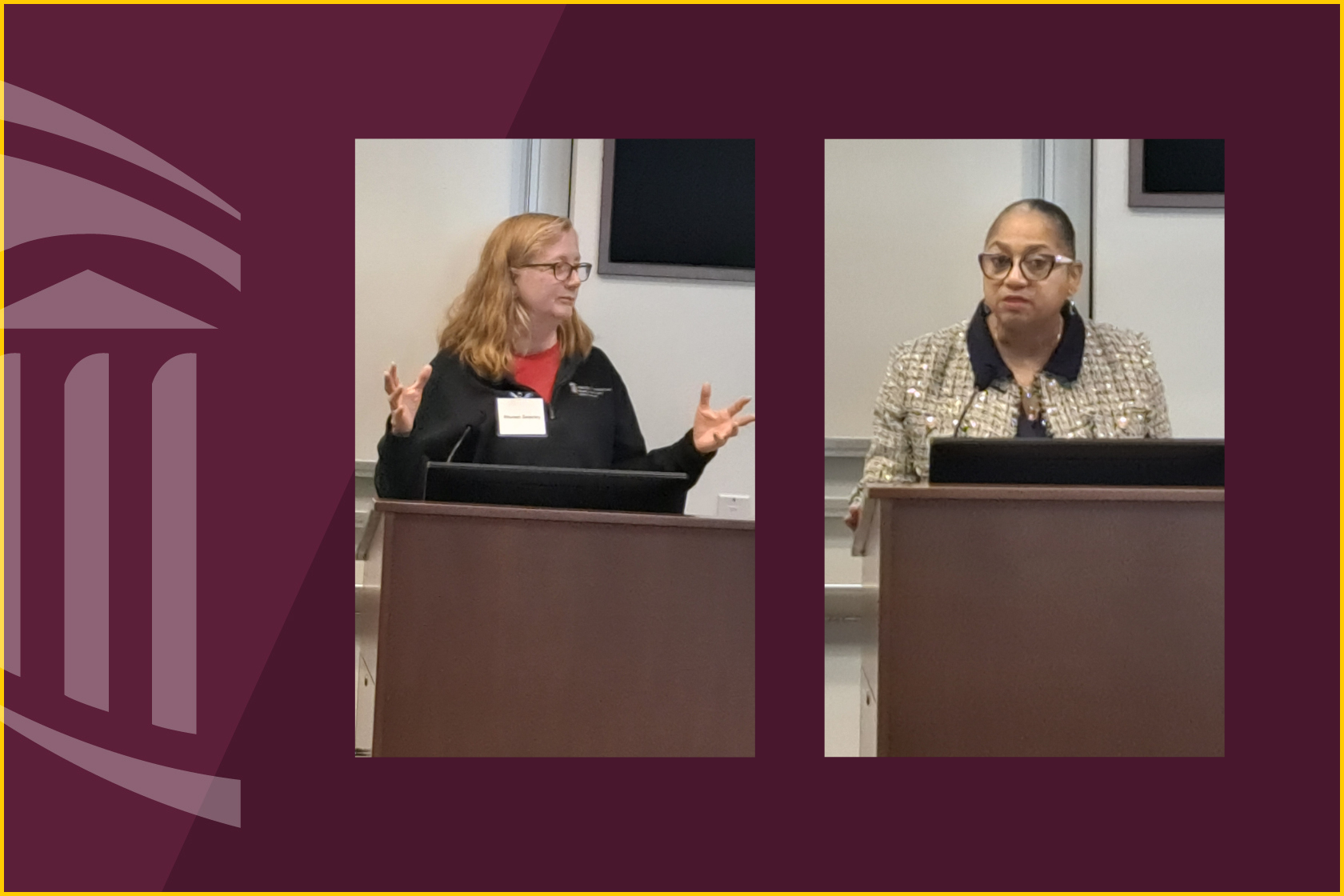
Above: Professor Maureen Sweeney, director, Chacón Center for Immigrant Justice (left) and Joseline A. Peña-Melnyk, speaker, Maryland House of Delegates
Community members crowded into one of the University of Maryland Francis King Carey School of Law’s spacious classrooms on a recent Saturday morning for a special training offered by the law school’s Chacón Center for Immigrant Justice.
Participants arrived with a desire to help citizens and immigrants whose rights have been violated by ICE or other federal agents. By the end of the three-hour workshop, they had practical tools to do just that.
Professor Maureen Sweeney, Chacón Center director, welcomed the attendees, most of whom were pro bono and public interest attorneys.
“I wish deeply that today’s training weren’t necessary,” said Sweeney, referring to the surge in aggressive federal immigration enforcement tactics, including arrests and deportations without due process, and physical assaults—even killings—of protesters and detainees.
Speaker of the Maryland House of Delegates, Joseline A. Peña-Melnyk, offered impassioned remarks before the workshop began. The speaker, who took precious time away from Annapolis during the legislative session to stop in, told her personal immigration story of moving to the United States when she was 8 years old to escape poverty in the Dominican Republic.
“This training is so important,” she said. “Our message is clear—immigrants matter, their lives matter. We cannot lose our democracy.”
Co-sponsored with the Migration and Human Rights Program at Cornell Law School and Together and Free, a national network of volunteers providing support to immigrant families in crisis, the workshop portion began with a short talk from Michelle Brané, a fellow at Cornell and Together and Free’s executive director.
Brané traced the recent history of the federal approach to immigration enforcement, starting with the high-profile arrests of international students and moving through the escalating violence in cities, dramatic increase in warrantless arrests, and rights violations of protesters and legal observers. She also provided statistical context, citing record deaths and a near doubling of families and unaccompanied children in ICE detention.
The heart of the training was an accessible introduction to the Federal Tort Claims Act (FTCA) as remedy for rights violations by federal agents, followed by detailed instruction on how to file administrative claims and how to represent clients if those claims proceed to litigation.
“The Federal Tort Claims Act offers a legal framework for plaintiffs to obtain compensation from the United States for the torts of its employees, but it is not very commonly used, so most attorneys aren’t familiar with it,” said Sweeney. “It is a vital tool in the current moment, though, because it is one of the few ways to get redress or accountability from federal officers.”
Participants were grateful for the workshop’s content and the opportunity to connect with each other.
“As a litigator contemplating how we can hold government agents accountable for harming citizens, I appreciate the Chacón Center hosting a training that provided concrete tools and guidance on using the FTCA for that purpose. I feel better prepared to help people in my community because I better understand the legal issues,” said Jean Zachariasiewicz, an attorney with the law firm Gallagher LLP. “Best of all,” she added, “I am now part of a network of other lawyers committed to this work.”
Attendee Megan Good '23, an Equal Justice Works Fellow at the Maryland Volunteer Lawyers Service (MVLS), participated in the Immigration Clinic during law school to prepare to provide pro bono assistance. "I never intended to practice immigration law full-time but given the attacks we are seeing on our communities, I feel compelled to pivot my practice once my Equal Justice Works fellowship with MVLS ends this summer," said Good. "The FTCA training was an extremely valuable resource as I work to build the skills necessary to join my colleagues in fighting civil rights violations in our federal courts."
The training was made possible thanks to a generous donation by two Maryland Carey Law alums. With this and other support, the Chacón Center intends to increase the frequency of trainings like this one.
“The need for attorneys with expertise in immigration law and other specialized areas has never been more urgent, and those attorneys are having to master new strategies and skills,” said Sweeney. “We are dedicated to increasing the capacity of Maryland’s legal community to advocate for clients navigating what has become an alarmingly dangerous immigration system.”
Plans are in the works for the Chacón Center to expand and offer more community programming and conferences to support practitioners, as well as partner with state, local, and other entities to support naturalization campaigns and other statewide initiatives.