
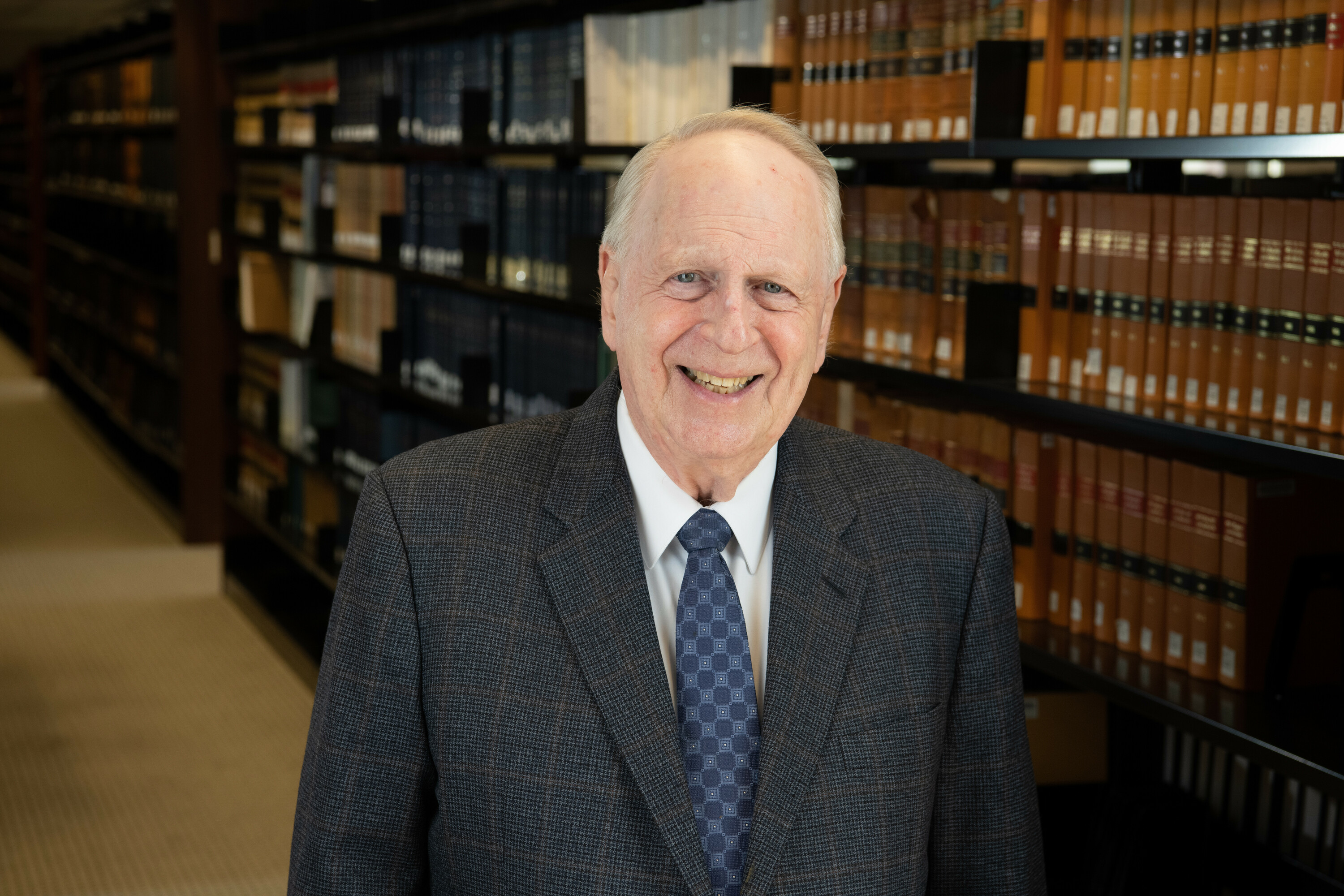
The University of Maryland Francis King Carey School of Law mourns the passing on Dec. 21 of Professor Michael Greenberger, a visionary institutional leader, nationally respected professor and legal scholar, and devoted public servant whose work profoundly shaped the University of Maryland, Baltimore’s (UMB) role in service to the state of Maryland and the nation.
Greenberger joined the law faculty at UMB in 2002 and, during his first year at the University, founded what was originally known as the Center for Health and Homeland Security. Established in the immediate aftermath of the Sept. 11 terrorist attacks, the center was launched from the University of Maryland Francis King Carey School of Law with an urgent and enduring vision: to create a nonpartisan, interdisciplinary center capable of translating academic expertise into practical guidance for leaders confronting complex and evolving threats.
Over time, the center evolved into what is now the Center for Cyber, Health, and Hazard Strategies (CHHS), reflecting Greenberger’s prescient understanding that cybersecurity, public health preparedness, emergency management, and national security risks are deeply interconnected.
“Michael Greenberger exemplified what it means to live UMB’s mission of knowledge in service to society,” said UMB President Bruce E. Jarrell. “By founding CHHS, he created a lasting institution that has strengthened Maryland’s preparedness, informed national policy, and demonstrated the essential role universities play in protecting the public good. His impact on this University and beyond will be felt for generations.”
From a One-Person Initiative to a Nationally Recognized Center
Under Greenberger’s leadership, CHHS grew from a one-person initiative into a nationally recognized center supporting public officials across Maryland and the country. For more than two decades, the center has advised governors, mayors, state agencies, and local jurisdictions on emergency preparedness, cybersecurity, continuity of government, public health crises, infrastructure protection, and systemic risk.
From the aftermath of 9/11 through the COVID-19 pandemic, CHHS played a central role in helping public institutions and agencies anticipate, respond to, and recover from crises, including critical support for emergency operations and vaccination planning. Today, CHHS remains a vital partner to the state of Maryland and a trusted source of applied policy expertise nationwide.
“Michael built CHHS with a clear sense of purpose and an unwavering commitment to public service,” said Markus Rauschecker ’06, executive director of CHHS. “He believed deeply that academic expertise must be actionable and accessible to decision-makers. The center’s continued work — here in Maryland and nationally — is a direct reflection of his leadership, values, and vision.”
An Enduring Impact on Students and Public Service Careers
A dedicated educator and mentor, Greenberger had a profound and lasting impact on students and staff. Through the academic arm of CHHS and his position on the Maryland Carey Law faculty, he oversaw the creation of the law school’s Cybersecurity and Crisis Management Program, which includes a certification option, and the Master of Science in Law programs in Cybersecurity and in Homeland Security and Crisis Management. LLM students at Maryland Carey Law can also specialize in Crisis Management or Cybersecurity. Greenberger designed and taught two courses in counterterrorism and emergency management and oversaw the development of several others. Additionally, he taught classes in cryptocurrency and financial derivatives regulations.
Greenberger’s scholarship included more than 20 articles published in top legal journals, three book chapters, and the 2005 Maryland Public Health Emergency Preparedness Legal Handbook, prepared for the Maryland attorney general and secretary of the then-Department of Health and Mental Hygiene.
During his tenure as director of CHHS, he hired hundreds of law students, helping to launch careers in emergency management, public policy, public health, cybersecurity law, and government service. Today, CHHS alumni hold prominent leadership positions across Maryland and throughout the nation. Greenberger’s mentorship also inspired Maryland Carey Law graduates to become CHHS’s next generation of leaders. They include Rauschecker; both associate directors Heather Shaivitz ’04, and Megan Timmins ’07; and program directors Trudy Henson ’08, Michael Vesely ’06, Christopher Webster ’10, and Ben Yelin ’13, many of whom are also lecturers at the law school.
Greenberger was a steadfast supporter of his students and colleagues, fostering a collegial, mission-driven environment that defined the center’s culture. He took great pride in CHHS’ work and its mission to serve and protect communities, and his legacy lives on in all those who had the privilege of learning from and working alongside him.
“Professor Greenberger was a visionary figure in legal education and a transformative member of our community,” said Maryland Carey Law Dean Renée Laurent. “His innovative work enabled our students to gain expertise in cutting-edge areas of the law both in the classroom and through incredible hands-on experience working for real-world clients at CHHS. His legacy will live on at Maryland Carey Law in the thriving academic programs he helped build from the ground up.”
A Distinguished Career in Law and Federal Service
Greenberger’s career prior to UMB was marked by distinguished public service and legal leadership at the highest levels of government.
He earned his JD in 1970 from the University of Pennsylvania Law School, where he served as editor-in-chief of the University of Pennsylvania Law Review. He was a Phi Beta Kappa graduate of Lafayette College, where he studied government.
His early career included service as a legislative assistant in the U.S. House of Representatives (1972-1973) and as a law clerk to Judge Carl McGowan of the U.S. Court of Appeals for the District of Columbia Circuit.
From 1977 to 1997, Greenberger was a partner at Shea & Gardner, where he argued before the U.S. Supreme Court multiple times and was widely respected for his legal acumen and commitment to public interest law.
He later served as principal deputy associate attorney general at the U.S. Department of Justice (1999-2001) and as counselor to the attorney general of the United States in 1999, under Janet Reno. Aspects of the department’s counterterrorism portfolio fell within his purview.
Greenberger was also nationally known for his leadership in financial regulation, including service as director of the Division of Trading and Markets at the Commodity Futures Trading Commission. He became widely recognized for his early warnings about the dangers of unregulated over-the-counter derivatives — concerns that later proved central to understanding the causes of the 2008 global financial crisis.
Throughout his career, he testified before Congress, advised policymakers across administrations, and was a sought-after expert on systemic risk, regulatory reform, and governance.
Greenberger’s dedication to public service extended beyond government and academia. His service included leadership roles with the Shea & Gardner Pro Bono Committee, Washington Legal Clinic for the Homeless, American Rivers (as director and secretary), and the D.C. Prisoners’ Legal Services Project, Inc.
A Lasting Legacy
Greenberger’s legacy at UMB is enduring. By founding and building CHHS, he created a lasting institutional platform that continues to serve the University, the state of Maryland, and the nation. And, through academic programs providing externship opportunities for law students at CHHS, he was instrumental in preparing lawyers and other professionals with the knowledge and skills to lead crisis management and prevention efforts.
He will be remembered as a builder of institutions, principled public servant, devoted professor and mentor, and scholar whose life’s work embodied UMB’s commitment to knowledge in service of society.