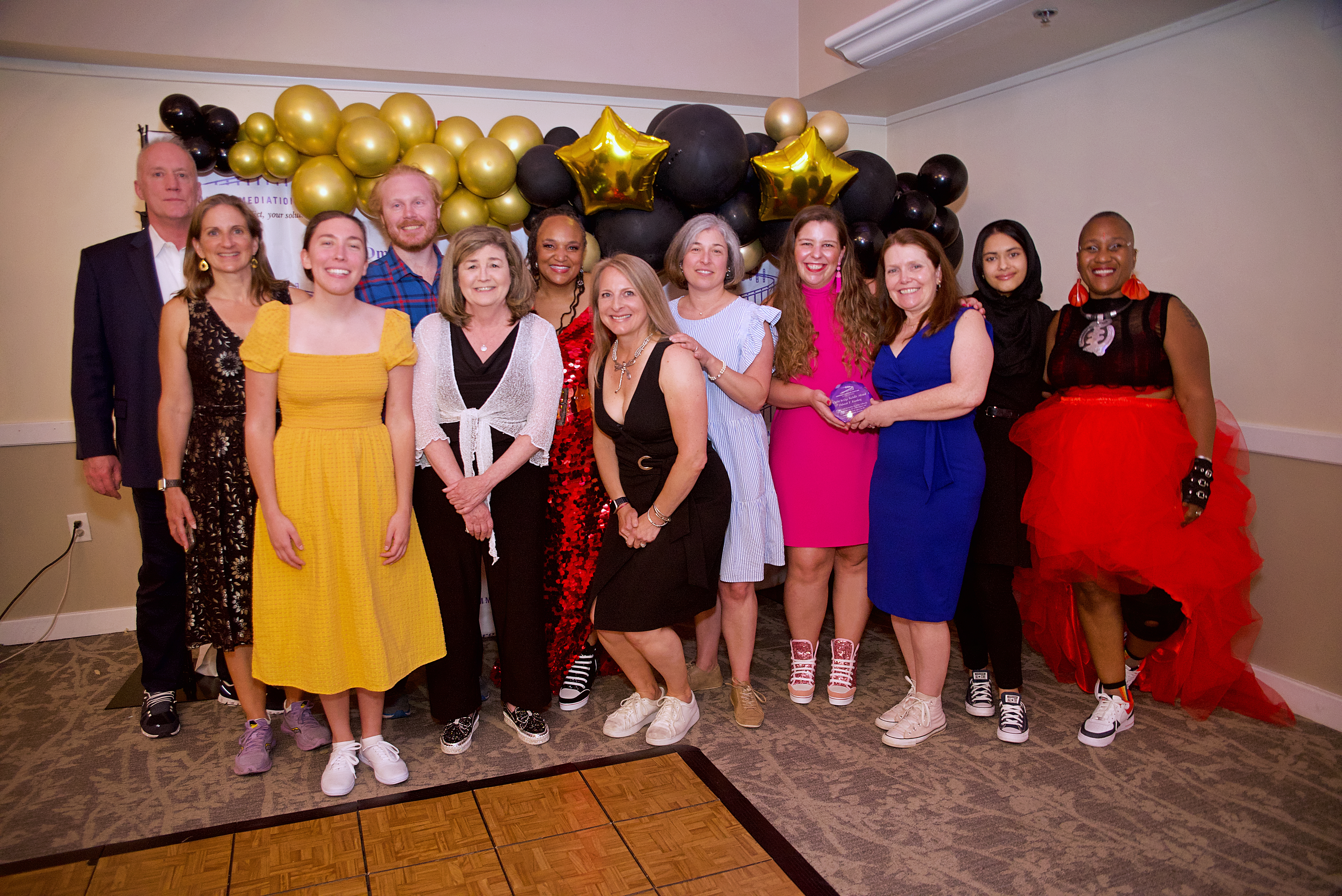
Photo: Former Jablow Fellows pose with representatives from the law school and CMM when Maryland Carey Law was recognized with CMM’s Bridge Builder Award
Cate Wilkins ’24 (third from left) knew her career path before she even started law school. Reading Bryan Stevenson’s book Just Mercy opened her eyes to the mass incarceration epidemic in the United States and cemented her decision to become a criminal defense attorney.
What she did not know was the part that mediation—an alternative dispute resolution process in which a neutral third party works with participants to help them resolve disputes—would play in her legal journey.
Enter the Ronna K. Jablow Mediation Fellowship offered through a partnership between the University of Maryland Francis King Carey School of Law and Community Mediation Maryland (CMM), an organization that provides community mediation services and supports centers that work in partnership with courts, schools, grassroots organizations, and government agencies to ensure access to mediation throughout Maryland.
After completing an extensive inclusive mediation training, students in the fellowship engage with a range of matters, such as helping formerly incarcerated individuals strengthen interpersonal relationships as they re-enter society; working with students, teachers, and parents to reduce violence and resolve conflict in school settings; and assisting those in addiction recovery rebuild family ties. They also have chances to conduct research in the alternative dispute resolution space and perform administrative functions behind the scenes at mediation centers.
Spending her 1L summer working at the nonprofit struck Wilkins as a meaningful use of time even if it wasn't a direct path to becoming a defense attorney. And, like Stevenson's book, the opportunity became a driving force in the Missouri native's career.
“I consider the Jablow Fellowship to be one of the most impactful parts of my law school experience,” said Wilkins.
That summer of 2022, she immersed herself in CMM's work, becoming a mediator and conducting related research. The job was so transformative that Wilkins stayed involved with the organization, joining the executive board while still in law school.
Today, she brings together her passions for criminal defense and community mediation working in the Maryland Office of the Public Defender's Post-Conviction Division and serving as president of the Community Mediation Maryland board.
The lessons learned through the fellowship are invaluable whether graduates choose careers in mediation or not, according to Toby Treem Guerin ’02, executive director for Maryland Carey Law’s Center for Dispute Resolution, through which the fellowship is administered.
Students in their first year of law school spend most of their time in doctrinal courses like Criminal Law, Contracts, and Property, so, for many, the summer fellowship is their “first experience sitting with people in conflict and helping them work through issues on their own terms,” said Guerin. “It is how they start connecting their classroom work and the kind of client-centered lawyering they will practice whether at a firm, a nonprofit, a government agency, or in a corporate setting.
Eric Peterson ’23 (fourth from left) spent his fellowship mediating community conflicts and developing outreach strategies at community centers in Prince George’s and Washington counties. Now, he is assistant counsel for the general magistrates at the Circuit Court for Baltimore City.
Peterson credited the intensive mediation training course and practical experience with helping him understand his own biases. “Being aware of my attitudes has made me a better listener and more well-rounded person,” he wrote in a reflection paper when the fellowship ended. “I think those are incredibly useful assets to have as I continue my legal journey.”
In its 10-year history, the family of Jablow Fellows has grown to 12, many of whom, like Wilkins, have remained connected to CMM as staffers, volunteer mediators, and board members.
Joanna Woodson ’22 (fourth from right) is now government and community affairs project manager at New York-Presbyterian, but after graduation, she worked full-time at Community Mediation Maryland as director of education, focusing on IEP (Individualized Education Program) mediation. In her reflection paper, Woodson wrote, “Heart is the way everything is accomplished at CMM, and the Jablow Fellowship opened the door for me to experience that world of care.”
The true heart of the Jablow Fellowship is the life and legacy of the woman for whom the experience is named: Ronna K. Jablow, an attorney and life-long advocate for mediation. After practicing law, she became a community mediator and went on to direct the alternative dispute resolution (ADR) program at the Circuit Court of Baltimore City. Under her leadership, ADR programs were strengthened and expanded. She also partnered with the Mediation Clinic at Maryland Carey Law, providing opportunities for law students to learn about court-based mediation.
Following Jablow’s death in 2015, her family established the fellowship to continue its namesake’s legacy in advancing the cause of alternative dispute resolution and supporting conflict resolution in the community.
As the fellowship celebrates 10 years building on Ronna’s legacy, her husband Matt reports that the program has exceeded the family’s hopes and expectations.
“It has made a real difference in many young lawyers’ lives,” he said, referring to former fellows like Wilkins, Peterson, and Woodson who were deeply impacted by the experience. “And it has been, and remains, a living, loving tribute to Ronna. That’s all we ever could have hoped for.”
Support the Ronna K. Jablow Mediation Fellowship.
Learn more in the Ronna K. Jablow Mediation Fellowship video.