
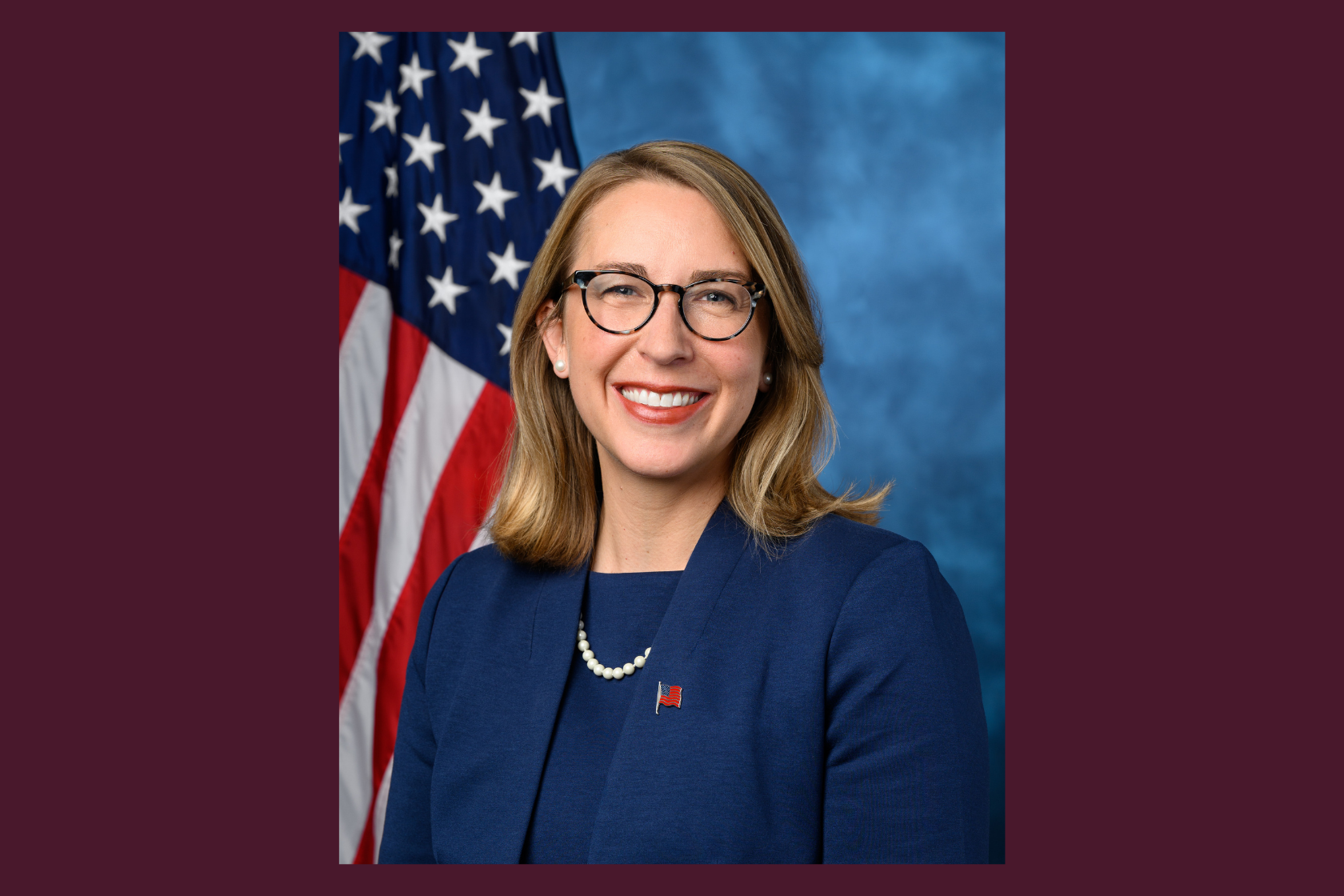
Hillary Scholten ’12 was walking out of a town hall meeting in Muskegon, Michigan in February 2023 when her phone blew up: The New York Times had just broken a story about migrant children who were working under unsafe and illegal conditions in her hometown of Grand Rapids.
“The very first thing I thought was, ‘Someone needs to call their congressperson!’” Scholten recalls.
It took her a moment to remember she was that congressperson.
Scholten had won Michigan’s Third District just two months earlier, flipping a seat that had been Republican for nearly 50 years and becoming the first woman to represent Western Michigan in the House. Prior to that, however, Scholten had spent most of her career working on immigration—both as an immigrant rights advocate and as an attorney at the Department of Justice. As a result, she knew that the fastest way to halt the exploitation of unaccompanied minors was to form an interagency task force between the Department of Labor and the Department of Health and Human Services. So, she called both agencies and the White House, and within a week the task force was up and running.
Few people would have been as well-equipped to address that kind of crisis. But Scholten was practically built for it.
Scholten grew up in a service-oriented household: her mother was a public-school teacher at a high-poverty elementary school, her father a sports reporter who favored underdogs.
“My parents showed me how to uplift people in our community who needed a voice and a champion,” she says.
Inspired by those early role models, Scholten initially pursued a career in social work. Her first job after graduating from college in 2004 was with the AIDS Action Committee in Boston, where she worked as a housing advocate for the LGBTQ community—an experience that helped spark her interest in the law.
“It was so powerful to see what one voice could do on behalf of someone else,” she says.
Her subsequent role as an accredited representative with Catholic Charities in Washington, DC, whetted her appetite further. While individuals in immigration proceedings lack a right to free counsel, non-attorneys affiliated with nonprofits can represent them before the Department of Homeland Security, the immigration courts, and the Bureau of Immigration Appeals (BIA). (The immigration courts operate as administrative courts within the Department of Justice, with the BIA serving as the highest administrative body for immigration law.) Scholten did precisely that before ultimately enrolling at Maryland Carey Law—and continued to do so as a student.
In law school, Scholten joined the Immigration Clinic, then led by Professor Maureen Sweeney. The clinic, which is now part of the Chacón Center for Immigrant Justice, represents low-income immigrants who have fled persecution, been subject to abusive enforcement practices, or currently face deportation due to criminal convictions. Scholten co-authored a journal article with Sweeney, who now directs the Chacón Center, about a 2010 Supreme Court case (Padilla v. Kentucky) in which the court ruled that defense attorneys must advise noncitizen clients about the potential immigration consequences of entering a plea. And as both an attorney and a legislator, Scholten continued to share Sweeney’s interest in asylum issues and the repercussions of criminal activity on immigration status.
“She is still, to this day, one of my most impactful mentors,” Scholten says.
Scholten’s dream was to do immigration and civil rights work for the Department of Justice–a dream that came true in 2013 when, after clerking for the special immigration unit of the U.S. Court of Appeals for the Second Circuit in New York City, she joined the Justice Department through the Attorney General’s Honors Program. Scholten served as an attorney advisor to the BIA in Washington, DC, working on high-stakes deportation cases– involving questions like, “Is this person going to have to go back? Will they face death?”–and developing a framework for treating victims of domestic abuse and systemic gender-based violence.
“It was incredibly consequential work,” she says. “You’re helping to craft decisions that shape immigration law across the country.”
Dismayed by the administration’s immigration policies, Scholten left the DOJ in 2017 to join the Michigan Immigrant Rights Center, where she helped represent every child that was brought to Michigan under the administration’s family separation policy. Some were just babies.
“That was some of the most harrowing and heartbreaking work that I have ever done,” she says.
Seeing how strongly many Michiganders opposed such policies, Scholten ran for Congress in 2020, lost—and won handily on her second attempt, in 2022.
Since then, she has worked on bipartisan legislation to reform the immigration system and protect unaccompanied migrant children. She has also voted against bills that she feels would undermine the integrity of the system and lead to abuse, whether by disproportionately penalizing immigrants for criminal behavior or facilitating human trafficking.
Going from advocacy to enforcement and back again before finally entering federal politics may seem like an incongruous series of career moves. But for Scholten, every step has been in service of the same goal she continues to work toward today.
“It seemed like one continuous job of working for a just, fair, and humane immigration system,” she says.
Editor's Note: This story was originally published in Maryland Carey Law's 2026 annual magazine.