
2026 Session of the Maryland General Assembly
Policy Priorities Wrap Up
June 2026
The Gibson-Banks Center for Race and the Law at the University of Maryland Francis King Carey School of Law (Gibson-Banks Center or Center) works with community members, government officials, and nonprofit organizations at the local, state, and national levels to clarify and protect the civil rights of racially marginalized groups. Below is a summary of legislation the Center supported or opposed during the 2026 Session of the Maryland General Assembly (MGA).
Youth and Criminal Legal Systems
Many laws and policies of Maryland’s youth and criminal legal systems disproportionately impact youth of color, particularly Black youth. The bills below seek to address these racial inequalities.
Limiting the Automatic Prosecution of Youth as Adults
✓ Supported/Passed: Senate Bill 323/House Bill 409: Juvenile Court Jurisdiction (Youth Charging Reform Act)
This legislation limits the number of offenses for which a child could automatically be charged in adult criminal court. It will allow the cases of more children to begin in the youth justice system where a judge may conduct a hearing to determine, on a case-by-case basis, if a child’s case should be moved to the adult criminal legal system.
While the Center has advocated for the complete elimination of Maryland's harmful policy of automatically charging youth as adults, SB 323/HB 409 is an important step in the right direction. It will place more children in the youth justice system, which is better equipped to address their needs as well as the alleged offenses. Black children bear the burden of the policy, comprising 77% of youth charged as adults statewide, even though they comprise only 30% of the youth population. Allowing more cases to begin in the youth justice system will have a positive impact on all children, particularly Black children, and is more efficient and effective than automatically charging children in the adult criminal legal system, where they are at much greater risk of physical and psychological harms.
You may click on the link to read the Center's written testimony in support of SB 323/HB 409.
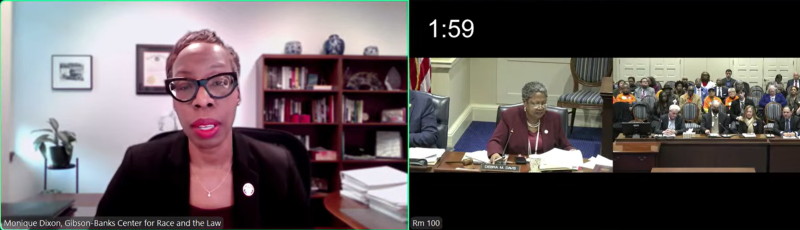
House Judiciary Committee, Maryland General Assembly YouTube (Feb. 12, 2026). Monique Dixon, the Center's Executive Director, provides oral testimony in support of House Bill 409.
|
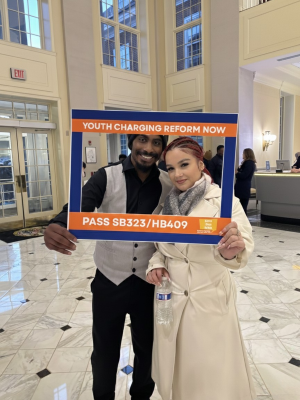
Rashad Hawkins, the Center's Community Fellow (left), and Jaely Marie attend event to support SB 323/HB 409. |
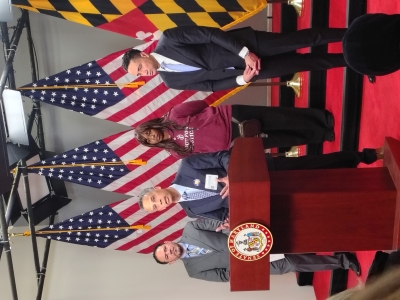 Prof. Michael Pinard, the Center's Faculty Director,
speaks at podium in support of SB 323/HB 409.
|
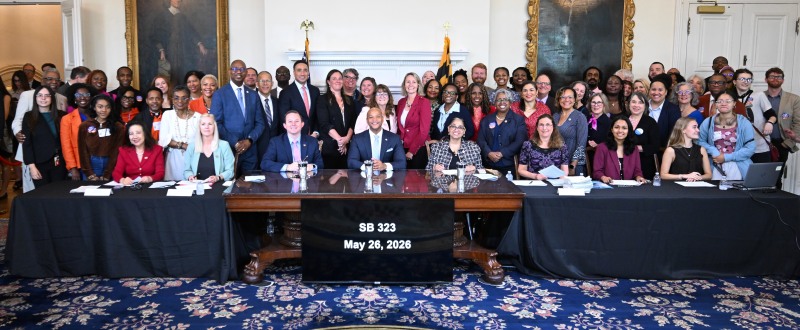
Maryland GovPics, Bill Signing Album, SB 323 (2026).
Investigation of the Gravesite at the Cheltenham Youth Detention Center
Last year, Maryland officials rediscovered marked and unmarked graves located in Prince George’s County near the Cheltenham Youth Detention Center, a centuries old youth facility formerly known as the House of Reformation and Instruction for Colored Children. News reports on the Cheltenham gravesite indicate that more than 200 Black children who were detained at or committed to the facility are believed to be buried there.
✓ Supported/Passed: Senate Bill 776/House Bill 552: Commission on the House of Reformation and Instruction for Colored Children – Establishment
SB 776/HB 552, among other things, creates a commission that would investigate the circumstances that led to the deaths of these children, account for every child buried in unmarked graves, and expose any failures of the youth justice system that was responsible for the children buried at the gravesite. The Gibson-Banks Center is named as a member of the Commission.
You may click on the link to read the Center's written testimony in support of HB 552, co‑authored by Erika Lewis, the Center’s Erek L. Barron Student Fellow.
Prohibiting Law Enforcement Use of Face Coverings and Requiring Identification
Current public safety policies in Maryland disproportionately impact communities of color, contributing to racial profiling, fear of law enforcement, and reduced accountability. Immigrant communities, particularly Black and Latine individuals, often face heightened risks of detention and deportation for minor conduct and are less likely to report crimes due to fear of law enforcement. At the same time, practices that limit officer transparency further erode trust in heavily policed communities.
✓ Supported/Passed: Senate Bill 1/House Bill 155: Public Safety-Law Enforcement Officers – Face Coverings and Identification
The bill will require the Maryland Police Training and Standards Commission to develop a uniform policy prohibiting certain law enforcement officers from wearing face coverings and requiring the use of worn identification while on duty. Maryland law enforcement agencies must adopt the policy.
You may click on the link to read the Center's written testimony in support of SB 1.
Homeownership and Fair Housing
Maryland has a shameful history of racial discrimination in housing, and the vestiges of this discrimination continue today. Housing policies in Maryland have negatively impacted Black residents, limiting access to homeownership and wealth accumulation. Practices such as discriminatory lending and exclusionary zoning have contributed to persistent racial disparities in housing opportunities, leaving many Black and other families with fewer options for stable housing. The bills below directly address these concerns by creating pathways for property ownership and transfer and by providing tools to combat discriminatory housing practices.
✓ Supported/Passed: House Bill 738/Senate Bill 651: Real Property Transfer on Death Deeds
HB 738/SB 651 establishes a framework for the creation, revocation, and recordation of a Transfer-on-Death Deed (TODD). A TODD is an estate planning tool that real property owners can use to transfer their property to one or more designated beneficiaries at the owner’s death.
The legislation serves as an alternative to more costly estate planning, such as will preparation. This bill’s passage is particularly important for low-income Black and Latine property owners, as research shows that they have high rates of intestacy. Additionally, HB 738/651 would align with states that have enacted TODD laws.
You may click on the link to read the Center's written testimony in support of HB 738/SB 651, co-authored by Kezia McDonald-McNeal, Student Fellow.
✓ Supported/Passed: House Bill 573-Fair Housing and Housing Discrimination
HB 573 will among other things, codify existing fair housing case law and affirm the availability of discriminatory effects analysis, also known as disparate impact theory, to prove housing discrimination.
You may click on the link to read the Center's written testimony in support of HB 573.
Equal Educational Opportunities
In 2022, Maryland legislators passed a law that prohibits education discrimination by PreK to grade 12 schools. The Maryland State Department of Education (MSDE) enforces the statute. This state law, however, leaves students in higher education institutions unprotected. These students often file discrimination complaints with the U.S. Education Department’s Office for Civil Rights (OCR), which enforces federal nondiscrimination laws. Despite these federal and state legal protections, allegations of education discrimination based on race, sex, or disability persist, as demonstrated by the over 270 allegations of discrimination against Maryland schools that OCR opened for investigation as of January 2025. The Gibson-Banks Center sought to protect students’ civil rights by supporting and opposing several bills below.
X Supported/Did Not Pass: House Bill 649: Advancing Equal Educational Opportunities for All Students in Maryland
The bill sought to strengthen and expand protections from education discrimination in Maryland. It would have prohibited discrimination against a student based on over a dozen protected characteristics, including race, sex, gender identity, sexual orientation, or disability by both PreK to grade 12 schools and higher education institutions.
HB 649 would have protected all students from policies and practices that treat them differently based on a protected characteristic, i.e., intentional discrimination, and policies and practices that have an unjustified discriminatory effect, i.e., disparate impact, on them based on protected characteristics. It would have authorized both MSDE and the Maryland Commission on Civil Rights (MCCR), an independent state agency, to investigate and resolve education discrimination complaints. Authorizing MCCR to investigate education discrimination complaints against PreK through graduate schools would have offered students and their parents or legal guardians another forum for filing complaints at the state level at a time when the federal government is unable or unwilling to do so.
You may click on the link to read the Center's testimony in support of HB 649, co‑authored by Erika Lewis, Erek L. Barron Student Fellow.
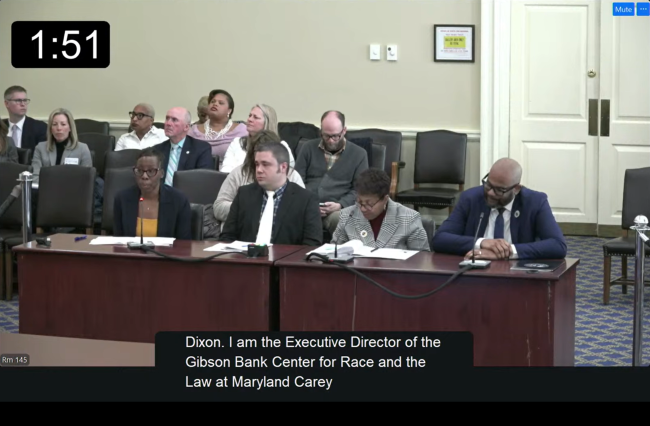
House Government, Labor and Elections Committee, Maryland General Assembly YouTube, Feb. 24, 2026.
Monique Dixon (far left) provides oral testimony in support of HB 649.
X Opposed/Did Not Pass: House Bill 198: School Systems-Reportable Offenses-Notification of Students as Suspect and House Bill 123: School Systems-Reportable Offenses – Alterations
Maryland law requires law enforcement agencies to timely and confidentially notify school officials of the arrest of and charge(s) filed against students for a reportable offense, which include crimes of violence. Upon receipt of this information, the school principal, in consultation with appropriate school staff, must consider whether the student should be removed from school because the student “presents an imminent threat of serious harm to other students or staff.” Black students, students of two or more races, boys, and students with disabilities are disproportionately arrested for reportable offenses.
HB 198 and HB 123 would have exacerbated these disparities by, among other things, expanding Maryland’s reportable offenses law to apply to students “suspected” of an offense (HB 198) and increasing the number of reportable offenses (HB 123). Ultimately, more students would have been at risk of being removed from school. Both bills did not move out of their respective House committees.
You may click on the links to read the Center's testimony opposing HB 198, and the Center’s written testimony opposing HB 123, both co-authored by Kezia McDonald‑McNeal, Student Fellow.
Voting Rights
The right to vote is fundamental. Voting rights protect and preserve other fundamental rights and is the highest form of civic engagement. Throughout U.S. history, Black people have been excluded from the franchise through various means. Today, disenfranchisement laws based on felony convictions continue to particularly impact Black people. According to the Sentencing Project, nationwide, “[o]ne in 22 African Americans of voting age is disenfranchised, a rate more than triple that of non-African Americans.”
X Supported/Did Not Pass: SB 89/HB 52: Election Law-Incarcerated Individuals-Voter Hotline and Voting Eligibility (Voting Rights for all Act)
SB 89/HB 52 would have, among other things, allowed individuals incarcerated in Maryland’s prisons the opportunity to vote in state and federal elections. You may click on the link to read the Center's HB 52 Gibson-Banks Center Testimony - (Favorable).
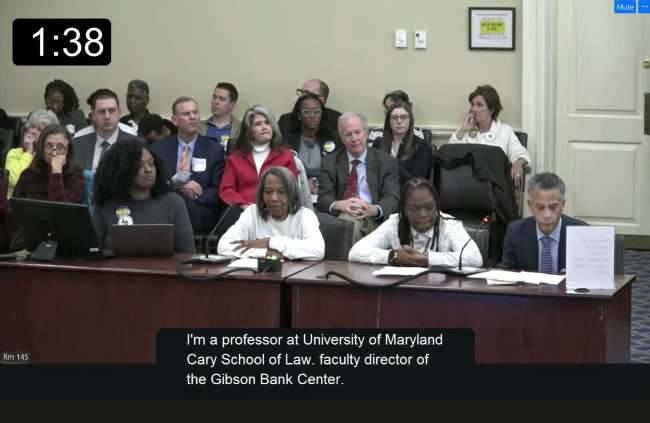
House Government, Labor, and Elections Committee, Maryland General Assembly YouTube, Feb. 24, 2026.
Prof. Michael Pinard (far right) provides oral testimony in favor of HB 52.