
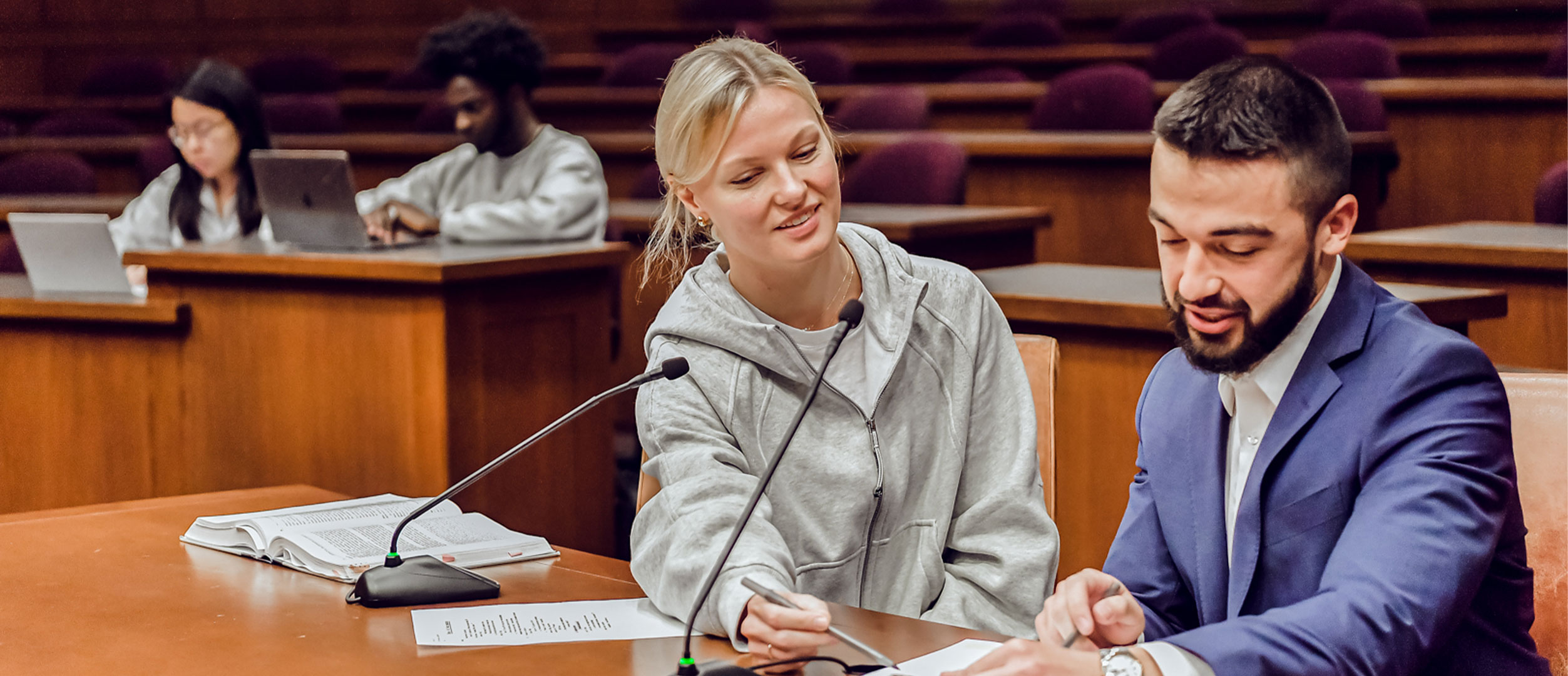
Maryland Carey Law's Legal Writing Center is available to enrolled students, of all writing abilities, who want to strengthen their legal writing. The Center maintains several resources for students, leads several workshops during the year, and provides a place for you to get individualized feedback on your writing from an upper-class legal writing fellow. Each fellow has demonstrated strong legal writing skills as a law student and received training to help peers improve their writing and written analysis.
To receive feedback and assistance from a legal writing fellow, you must book an appointment using our online scheduling system, WCOnline (instructions below).
Schedule Writing Center Appointment
All registered students also are automatically enrolled in the Legal Writing Center’s Blackboard page, which contains the Center’s digital resources and announcements of upcoming workshops and fellow selection process. The Center’s available resources include:
- guidance on various Lawyering skills, on drafting a memo or appellate brief, and on presenting an oral argument;
- guidance and examples for writing a scholarly paper, including a paper that satisfies the Advanced Writing Requirement;
- information on becoming a legal writing fellow and on “petitioning” to join a law journal;
- updated list of writing competitions;
- and tips and examples for writing samples that you might prepare for a legal employer.
FAQ
You can seek assistance from the Legal Writing Center with any law school-related writing: Lawyering assignments, seminar papers (including those intended to fulfill the Advanced Writing Requirement), https://www.law.umaryland.edu/academics/jd-program/curriculum/advanced-writing-requirement, clinic work, writing for a school-sponsored extracurricular activity, and writing samples for legal employers. In some instances, your instructor may impose limits on your use of the Center, and you should always seek permission from your instructor if you are seeking assistance on any document that contains privileged or confidential information. You should not seek assistance on written work product for an external position, such as an externship, internship, or summer law office position.
For Lawyering assignments, students can receive assistance on targeted skills or specific portions of a draft only, as noted in your syllabus. The Legal Writing Fellows will not review or provide comments on entire Lawyering drafts but will help you develop specific skills, such as writing a synthesized rule statement, strengthening your active voice, or organizing your legal argument. Guidance on these and other skills also can be found on the Legal Writing Center’s Blackboard page.
The Legal Writing Fellows can help you at all stages of your writing process. They are prepared to comment on most aspects of your writing, from active voice, citation form, style, and small-scale organization, to large-scale organization and analytical coherence. However, because the Legal Writing Fellows will not be experts in specific substantive topics, their comments will not address the accuracy of your paper's substance.
The Legal Writing Fellows will engage you in a collaborative process that helps you think through the problem posed by your assignment, spot patterns of writing problems, and focus on the intended reader’s expectations. Their feedback should help you develop the skills to edit, revise, and improve your own legal writing longer term.
The Legal Writing Fellows are not editors and will not rewrite, proofread, or correct your papers (or your citations). You also should not expect to come to the Legal Writing Center for last-minute "fixes" the night before a paper is due.
To consult with you on your written work, Legal Writing Fellows require at least 72 hours to review lawyering assignments that are up to 4 pages and 72 hours to review seminar paper submissions and other legal writing papers that are up to 10 pages.
You can schedule an appointment using our web-based scheduling program, WCOnline https://www2.law.umaryland.edu/WCOnline/. Here’s how it works:
You must first log in using your student email address and password. On your first visit to the site, you must also register specifically as a student user of WCOnline (using the link that states, “Non-administrators must log in to this program here”). On future visits to WCOnline, you will be able to log in using only your student email address and password.
Once registered, you will see the Writing Center schedule, with the legal writing fellows’ names on the left side and openings for appointments in white, be sure to select the schedule from the drop-down menu for the current semester. Click on a white space and fill in your appointment information in the new window.
You can schedule an online, face-to-face, or e-feedback consultation. Online appointments will be conducted by Zoom using the integrated feature in WCOnline, and face-to-face meetings will be held at the law school in the Writing Center study (Rm. 400A). E-feedback (referred to in WCOnline as “e-tutoring”) means that a fellow will review your writing project, make electronic comments in the document, and return the document to you without a consultation. E-feedback is not available for Lawyering assignments.
When you schedule an appointment, you will be prompted to fill out an online questionnaire form, you will identify the type of writing project, indicate the assistance you are seeking, and attach your draft for review. Please be as specific as possible when you complete the questionnaire. The more we know about what you hope to accomplish during your appointment, the better prepared we will be to help you.
IMPORTANT: After completing the appointment information, remember to click on the “Save Appointment” button. You will see a message confirming that your appointment was created, as well as an email confirmation.
To cancel an appointment, log in to WCOnline, double-click the colored box for your appointment time, and select “Cancel Appointment.”
If you must change/cancel and appointment, please do so as far in advance as possible and at least 120 hours (5 days) before your scheduled appointment time. To cancel within 120 hours (5 days) of your appointment, email the Legal Writing Center at legalwritingcenter@law.umaryland.edu.
NO SHOW/CANCELLATION POLICY: A student who either (1) cancels an appointment within 120 hours (5 days) of a scheduled appointment twice during the semester or (2) misses two appointments without cancelling during the semester will be unable to obtain a consultation or e-feedback the remainder of that semester.
Outstanding Student Papers in the DigitalCommons @ Maryland Carey Law
In 2006, the law school established an area within the DigitalCommons repository of law school scholarship to collect and highlight outstanding student papers.